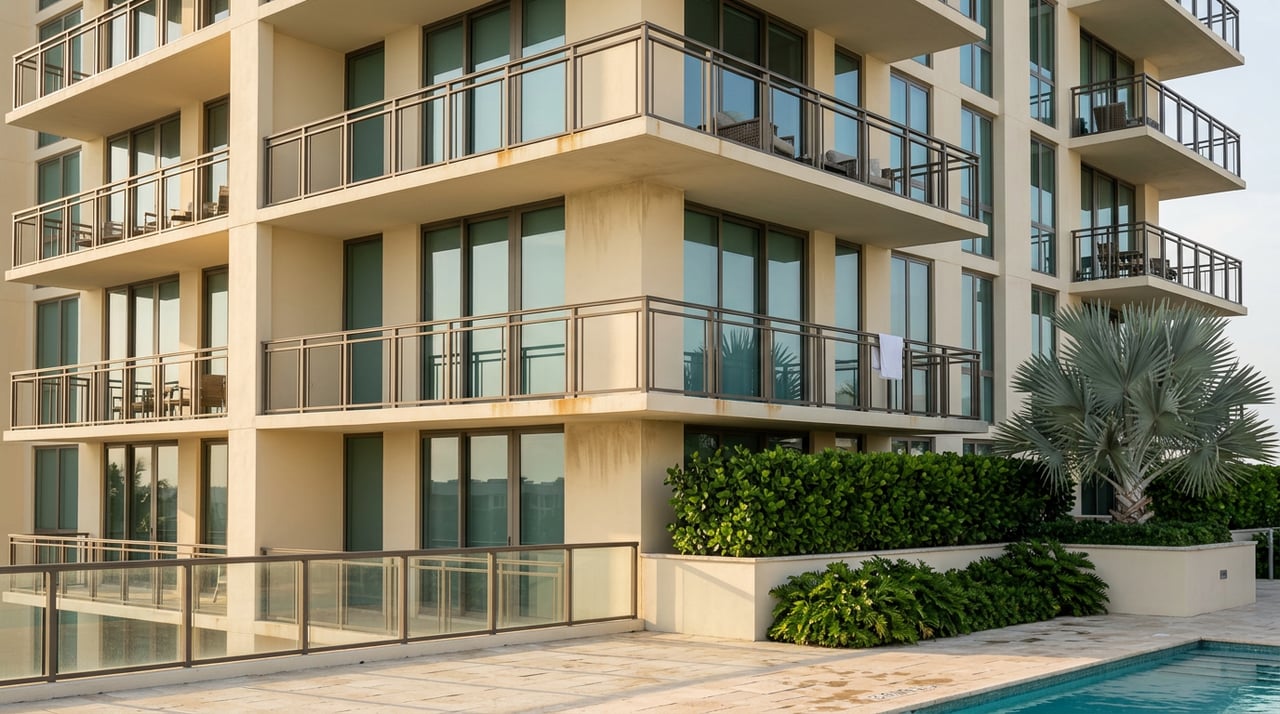
Fort Lauderdale Beach Condos Can Pass Every Inspection and Still Fail the Loan
September 24, 2026
September 24, 2026
A condo on Fort Lauderdale Beach can clear its milestone inspection, finish its structural integrity reserve study, and still watch a conventional mortgage fall apart in underwriting. That is not a hypothetical for buildings closing this month. It is the direct result of a lending rule that took effect on August 3, 2026, one that most buyers writing offers on Galt Ocean Mile or Central Beach towers have not heard of yet, because the building next door might be sailing through the same process without a hitch.
The reason has nothing to do with concrete or rebar. It has to do with how a building's association chooses to fund its reserves on paper, and whether a lender still recognizes that choice.
Every conversation about older South Florida condos starts with Senate Bill 4-D, the state law passed after the 2021 Champlain Towers South collapse. It requires condo and co-op buildings three stories or taller to complete a milestone structural inspection once they hit 30 years of age, or 25 years if they sit within three miles of the coast, and then every 10 years after that. Fort Lauderdale Beach, sitting almost entirely inside that three-mile band, runs on the 25-year clock. The full statutory language is public, and the Florida Division of Condominiums maintains the compliance guidance that boards use to track deadlines.
What buyers researching from out of state often miss is that Broward County has been running its own version of this inspection for two decades already. The county's Building Safety Inspection Program dates to 2005 and became effective countywide in January 2006, modeled directly on a Miami-Dade program that goes back to the mid-1970s. It required structural and electrical safety inspections once a building turned 40, then every 10 years after, and it applies more broadly than the state law does, covering commercial buildings and any structure over 3,500 square feet, not just condos. A recent update moved the county's own trigger age down to 25, effectively syncing it with the state milestone timeline for most qualifying buildings.
The full text of Broward's Building Safety Inspection Program is worth reading before you assume one inspection covers everything. A structural engineer can often scope a single report to satisfy both the state milestone requirement and the county's own program, but a buyer's due diligence should confirm both boxes are checked, not just one.
This dual regime only exists in Broward and Miami-Dade. It is a distinction that matters if you are comparing a 1970s tower on Galt Ocean Mile, whose 1,970-something certificate of occupancy has been living under some version of this oversight since before most of today's buyers were born, against a newer building elsewhere in Florida that only started worrying about structural inspections after 2022.
Passing both inspections used to be the finish line. As of August 3, 2026, it is the midpoint.
On March 18, 2026, Fannie Mae issued Lender Letter LL-2026-03, a coordinated update to how it and Freddie Mac evaluate condominium projects before backing a mortgage. Two pieces of that letter took effect on August 3 and are already shaping which Fort Lauderdale Beach buildings a buyer can finance conventionally today.
The first eliminates baseline funding as an acceptable reserve strategy. Reserve studies typically present three funding paths: baseline, which lets the reserve balance drift down to just above zero and back up again; threshold, a moderate middle path; and full funding, which keeps reserves close to 100 percent of the fully funded balance at all times. For years, an association could adopt baseline funding, keep monthly assessments lower, and still qualify for Fannie Mae backing as long as it had a reserve study on file. That exception is gone. Lenders relying on a reserve study to demonstrate adequate reserves must now confirm the association's budget reflects the highest funding level the study recommends, and baseline no longer counts as a valid option under any circumstances.
The second retires the Limited Review process entirely. Limited Review used to let lenders skip a deep financial dive on established buildings for certain loan types. Every project with more than 10 units now goes through Full Review, which means a closer look at the association's budget, insurance coverage, delinquency rate, litigation history, and reserve documentation on every single loan application, not a sample.
| Funding method | What it means | Status after August 3, 2026 |
|---|---|---|
| Baseline | Reserve balance allowed to approach zero, never fall below it | No longer accepted by Fannie Mae or Freddie Mac |
| Threshold | Reserve balance kept at a set minimum above zero | Accepted if it is the study's highest recommended level |
| Full funding | Reserves kept near 100 percent of fully funded balance | Accepted |
An older Galt Ocean Mile tower that completed its milestone inspection and its structural integrity reserve study on schedule can still hand a lender a reserve study built on baseline funding, because nothing in Florida's own SIRS law requires full funding, only that the eight mandatory structural components stay funded according to whatever schedule the study recommends. That gap between what satisfies the state and what satisfies the mortgage market is exactly where deals are getting stuck right now.
The same March letter that tightened the rules for established towers loosened them in two places that matter on this stretch of beach.
Fannie Mae expanded its Waiver of Project Review to cover new and established buildings of 10 units or fewer, a category that includes plenty of the smaller boutique projects scattered through Fort Lauderdale Beach's redevelopment pipeline. It also eliminated its 50 percent investor concentration limit, which had been flagging buildings with heavy rental or investor ownership as ineligible for conventional financing. On a beach where second-home buyers and short-term rental owners make up a real share of the buyer pool, that cap's removal opens financing back up for units that used to get stuck with cash-only or non-warrantable loan terms.
The letter also retired a longstanding requirement that new or newly converted Florida projects with attached units go through Fannie Mae's separate Project Eligibility Review Service before qualifying. New towers now marketing on Fort Lauderdale Beach, including Selene Oceanfront Residences, the new Ritz-Carlton Residences on Bayshore Drive, St. Regis Resort & Residences Bahia Mar, and Riva Residenze, can move through the standard lender-delegated Full Review process instead, which is a smoother path for the buildings that were already going to be easiest to finance.
The pattern that emerges is not old buildings versus new ones. It is paperwork versus paperwork. A 1970s Galt Mile tower with a full-funding reserve study and a clean milestone record can qualify without issue. A newer building with more than 10 units and a lender-facing reserve study that has not caught up to threshold or full funding can hit the exact same wall.
The building's price bracket will not tell you which side of this line it falls on. Its paperwork will.
None of this replaces a conversation with a lender who underwrites Florida condo loans regularly. It does mean you can walk into that conversation already knowing which questions matter, instead of finding out during a 30-day financing contingency that the building's reserve study needs to be redone before your loan can close.
Does any of this apply if I am paying cash? No. Fannie Mae and Freddie Mac review project eligibility because they are backing a mortgage. A cash purchase bypasses that review entirely, though a smart buyer still wants to know the reserve funding picture before buying into an association that might levy a special assessment later.
Do brand-new towers like Selene or the Ritz-Carlton Residences need a milestone inspection? Not yet. The state's 25-year clock starts from the certificate of occupancy date, so newly delivered buildings will not face their first milestone inspection for decades. They are still subject to Fannie Mae's Full Review process for financing purposes, which is a separate question from structural compliance.
How do I find out if a specific building is already flagged? Your lender can run the address through Fannie Mae's condo project eligibility tools once you have identified a building. It is worth doing before you get deep into a contract, not after.
If you are weighing an older tower on Galt Ocean Mile against something newer closer to Las Olas, the honest answer is that the building's own reserve documentation matters more right now than which decade it was built in. Lauren Kahn Group works through this kind of due diligence with buyers and sellers on Fort Lauderdale Beach every week. Contact Lauren for a personalized market consultation before you write an offer, not after the loan gets flagged.
Stay up to date on the latest real estate trends.

With Lauren's help, you can easily find your dream home in South Florida. So what are you waiting for? Start searching today and be one step closer to finding the perfect place to call home!